
Human population growth and globalization have dramatically increased our environmental footprint, leading to a global climate and biodiversity crises. Introductions of non-native species, among other stressors, have significantly affected aquatic ecosystems. As the rate of species invasions increases globally, it is essential to determine the origin and transport vectors that have facilitated their range expansions. Accurate identification of the source populations and associated transport vectors enables development of management strategies and prevention of new invasions. It also allows the formation and testing hypotheses related to fundamental tenets of invasion science – importance of propagule/colonization pressure, genetic diversity, enemy release, or associated microbiome as mechanisms underlying invasion success. In many cases, non-native species undergo major habitat transitions and so understanding their genetic and phenotypic responses, can shed new light on the ability of colonizing species to adapt rapidly during range expansions. Given the widespread native ranges of many non-native species, coupled with the difficulty involved using traditional taxonomy for their identification, phylogeographic studies and molecular identification can be of benefit in tackling many of the above problems.
Resistance to multiple stressors facilitates establishment and spread of non-native species in new habitats. The same resistance may enable species to survive in habitats highly affected by global change (e.g., elevated temperature and pCO2 regimes, light, noise and heavy metal pollution). Consequently, non-native species may be predisposed to flourish in the future global change scenarios, while species proved tolerant to the changes connected with anthropogenic activities may become non-native species in the future. Likewise, studies in invasion ecology – particularly those on factors affecting success and failure of introduced species – provide important contributions to conservation ecology and evolution. The traits commonly listed as increasing invasion success of species, when opposite in sign, those traits listed as increasing vulnerability to extinction.
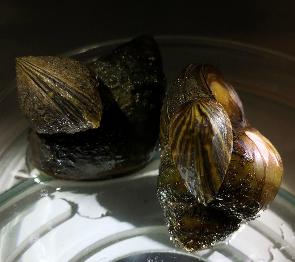
More than we bargained for: Zebra mussels transported amongst European native freshwater snails. Here, we document the discovery of invasive zebra mussels, Dreissena polymorpha, transported alongside a commonly traded garden pond snail and European native, Viviparus viviparus, ordered from a pet website.
We are interested in a broad variety of questions pertaining to invasion ecology and global change biology. Our current work focuses on importance of geographic origin for invasion success, and invasion risk and impacts of non-native species under current and future global change scenarios. Our research also covers adaptation and evolution of diverse taxa, independently of their native or non-native history, to anthropogenic stressors and urban environments. Finally, our work also leads to an interest in restauration and conservation studies.